August MBA: Why people buy bullshit
TL;DR
A good idea is a balanced idea, and business needs geometry; People often buy being someone
Ideas need balance and businesses need geometry
Between idea and execution, I'm on Team Idea: if an idea is good but the execution doesn't work, just keep trying until it does; if an idea is bad, even the best team can't make it work.
├─ What's a good idea
I've come up with these pairs of parameters:
- Scalability vs. Solution Quality (SQ)
- Problem Quality (PQ) vs. TAM
Solution quality competes with scalability because (generally speaking) the higher the quality
of the product, the more difficult it is to produce it in large quantities.
The same applies to TAM and PQ: the more sophisticated and complex a problem is, the fewer
people/companies face it.
I'll give some examples from marketing, since that's where I started defining the model:
Problem Quality (PQ)
- "I need to run a campaign for a product" → low PQ
- "I need to launch a new product in a new market on a new continent" → high PQ
Solution Quality (SQ)
Problem: "I need to run a campaign for a product"
- "Let's run a Meta Ads campaign using the agency's template." → low SQ
- "Let's define what the campaign needs (ICP, suitable channels, target CAC...), then build the campaign around that definition" → high SQ
The best way to represent this model is using this radar chart:
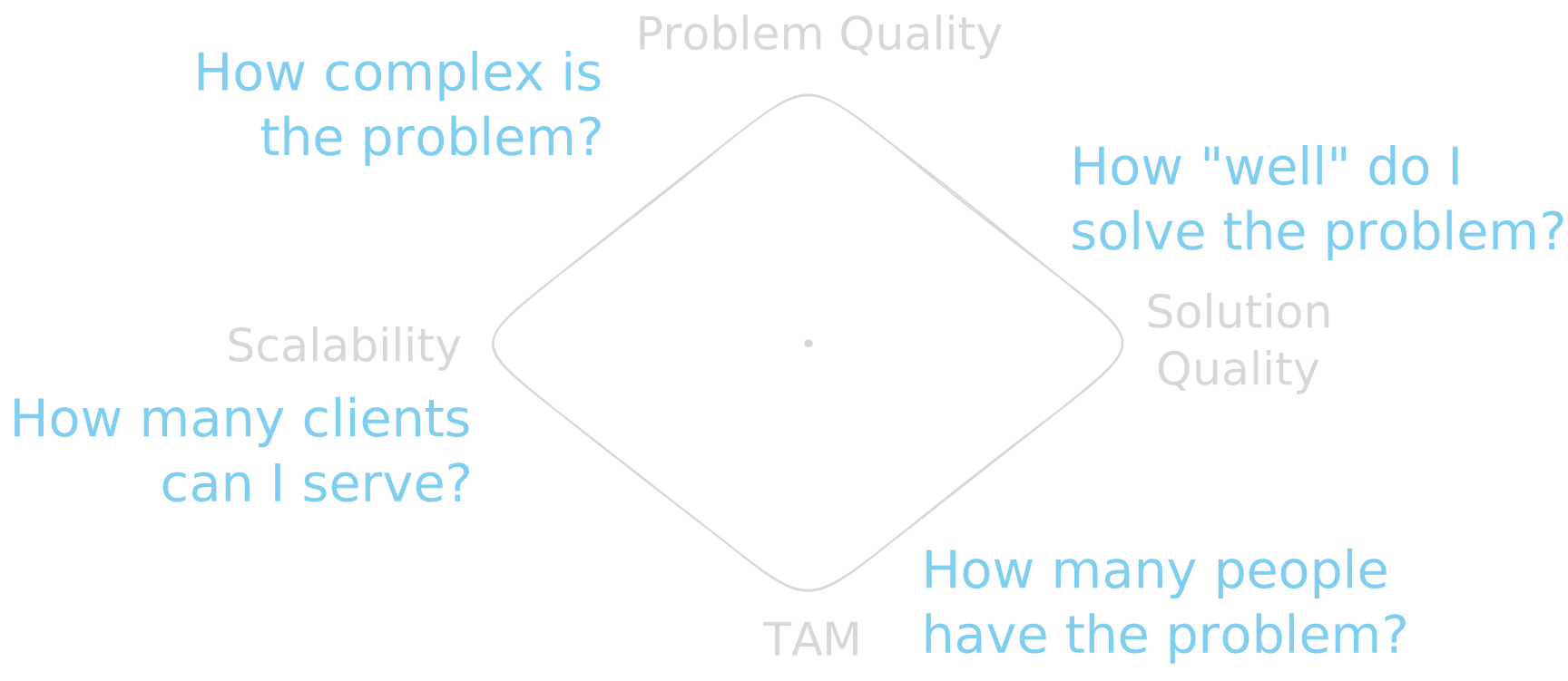
PQ and TAM, as well as Scalability and SQ, are on opposite sides because "opposites pull the blanket toward themselves".
├─ Role of execution: honest vs parasitic imbalance
A good idea is a balanced idea.
But it's not just about the idea: it's also about execution.
I see execution as charting a trajectory that takes you from zero to the closest possible realization
of the idea.
I'm convinced that the two fundamental qualities for a company are:
- Starting with a balanced idea (FUNDAMENTAL)
- Bridging the gap between theory and practice through execution, moving toward the theoretical chart balance
A company never starts out perfectly balanced (especially startups) and has to sacrifice certain aspects of
their strategy at first.
But there's a difference between the "early-stage growth-at-all-costs" imbalance and the
"staying forever pinned to high TAM while quality stays near zero" imbalance: the exploitation of
information asymmetry.
As I said: I came up with this chart with marketing agencies in mind, which I hate.
They are the definition of parasitic imbalance:
- High TAM: everyone thinks they need marketing
- High scalability: AI content production nearly free
- Near-zero quality of problem: clients can't define CAC, CPL, or goals. They "need marketing for this event/launch"
- Near-zero quality of solution: agencies do not produce results (see any italian marketing agency website: no CAC, CPL, ROAS in view) but volume.
Summing up: an imbalanced chart.
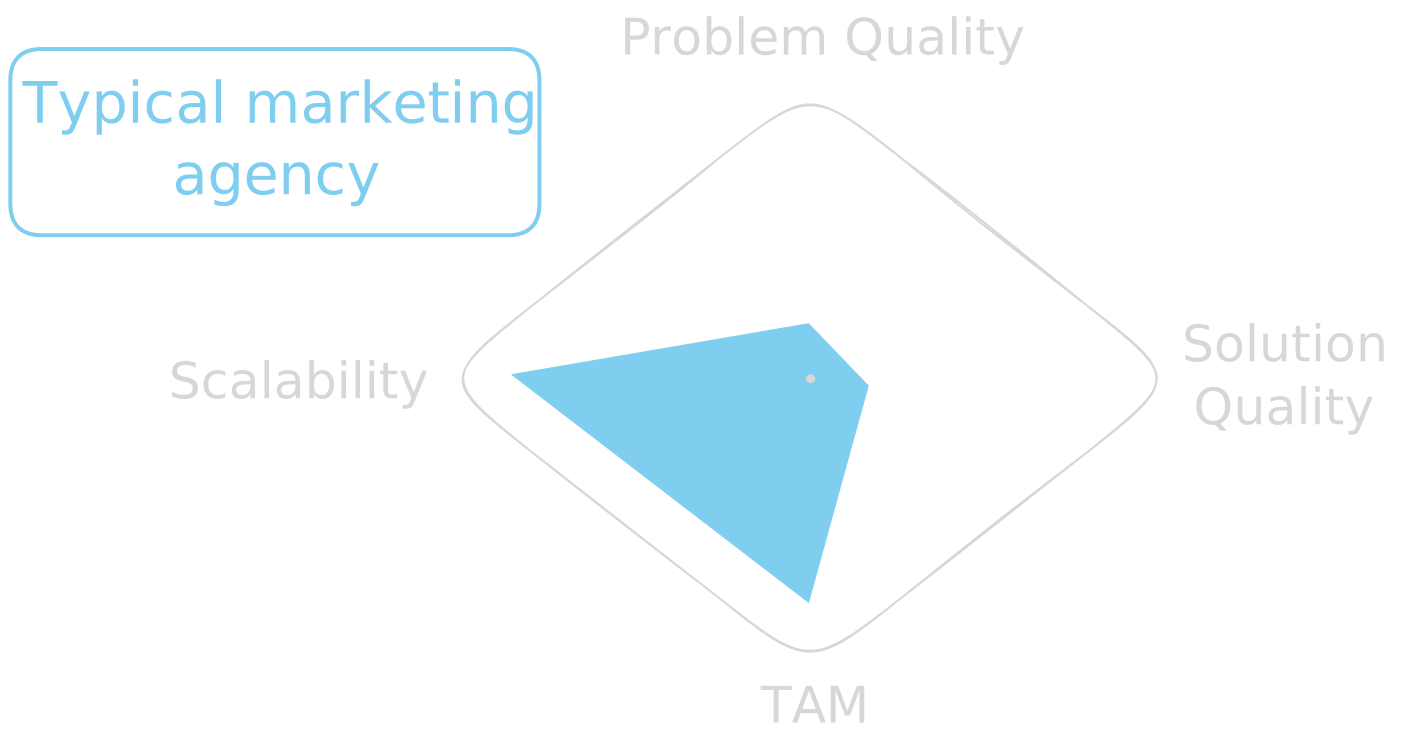
The idea behind a marketing agency of this kind is: "We create meta ads for those who can't do it
themselves."
It starts from an unbalanced chart, the execution can only realise the fundamental imbalance on which the
business is based.
But they don't all have the same chart.
All it takes is for an agency to specialise in more expensive advertising with a more specific ICP
(start-ups only, food brands only, etc.) for the chart to change significantly.
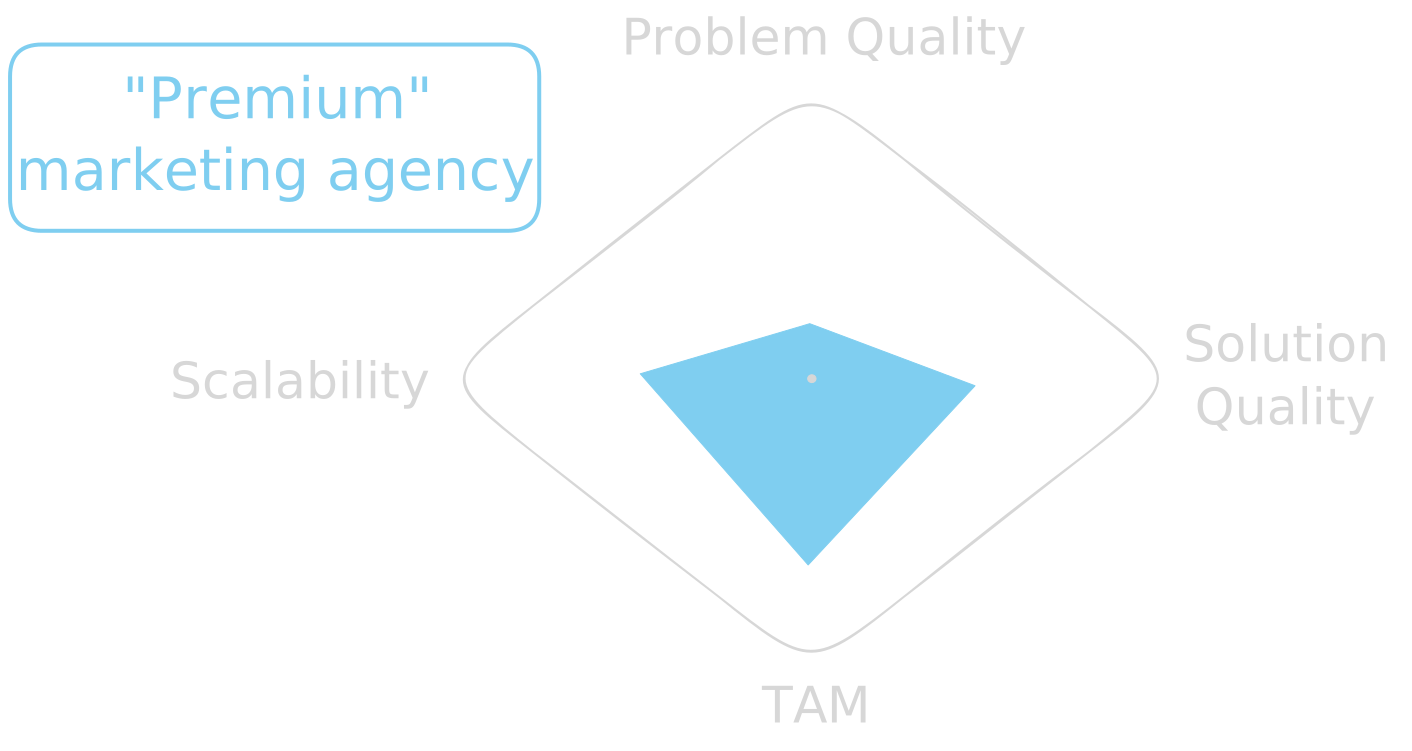
It doesn't mean they're any better or any less "parasitic": they're simply... different.
Example
Have you ever heard of Perplexity but aren't quite sure what it is?
I've got 3 spots for you.
After watching them, answer these questions:
- What's the difference between Perplexity and ChatGPT?
- Does Perplexity have all the features of ChatGPT?
- Why should you switch to Perplexity instead of sticking with ChatGPT/Claude/...?
The adverts say nothing about it, and they do what an advert should never do: treat the viewer like an idiot.
But these adverts don't "just do that"!
They do it in premium style: they must have cost a fortune, because the cinematic quality is
remarkable!
So the quality of solution goes up and scalability goes down.
The TAM might go down because not all companies can afford it, and the problem quality remains
embarrassingly low.
└─ Business geometry
We've talked about TAM, scalability, and problems and solutions.
But in reality, we're talking about business geometry.
How much of the TAM should we cover?
How much work should we put into the product?
Which problem should we tackle?
These are questions the business must ask itself as execution drives it to evolve over time.
The point is:
The idea defines the business geometry, execution propels the business in that
direction.
Identity Based and Problem Based
The most important question I've asked myself these past months is: "Why do people buy bullshit?"
How is it possible that people buy dozens of thousand-euro writing courses of dubious quality?
Why do companies buy services from marketing agencies that don't know how to do their job?
And above all: how can you sell services like these, where there's no real exchange of value?
Because people buy being someone:
- Problem-based purchase: has a measurable problem, buys the tool that solves it
- Identity-based purchase: has identity doubts
├─ Identity-based purchase
Learning to write is like any other subject: you can start from manuals, from free resources online...
This should get you to a level good enough to tell which courses are fluff and which aren't.
Once you're there, ONE (1) course can help you finish the book, by working with people who know what
they're doing and getting you to the level only a mentor can get you to.
And yet nobody does it this way.
Because the goal isn't learning to write: the goal is feeling like a writer.
It's answering "Oh, I'm writing a book, actually, a noir set in Italy..." when someone asks "So
what have you been up to lately?".
It's correcting a drunk friend's grammar and saying "...yeah, I notice these things, I'm a writer, you
know...".
So they buy whatever makes them feel like a real writer: expensive schools, courses with fancy names,
courses courses courses.
Companies do the same thing with marketing: they want to feel like companies that do marketing.
It doesn't matter if an online campaign is the worst possible fit for the product: a real company goes to
an expensive marketing agency and gets a campaign made, PERIOD.
Which is exactly why marketing agencies can get away with that business geometry above.
The business perspective is as follows:
- For the buyer, it's a way to pass off a low-quality problem as a high-quality one ("I’m not just some kid messing around with Word!")
- For the seller, it's a way to price a rock-bottom PQ problem as if it were high-PQ
A win-win... sort of.
And amazingly: TAM doesn't move at all!
We're not talking about complex niche problems, we're talking about trivial problems everyone has,
dressed up as complex ones.
NOTE
This post builds on the concept of identity, but I've already covered these examples through a different lens here and here.
├─ Problem-based purchase
When the client has a real problem, what matters is how the product solves it and how much it costs.
They have a problem, they have requirements, they have a budget: they have a need.
├─ Marketing, cost, and value
It's obvious how a problem-based product works: it has to solve a problem, do it for a fraction of the cost
of living with that problem, and make the target understand how it solves it.
An identity-based product is playing a different game.
Identity is a matter of cached behavior and self-aggrandizing[Excellent post, highly
recommended!]: whoever feels like a writer does what they believe writers do, and feels
cooler than someone who's never written a word.
The marketing has to tell the aspiring writer that only real writers buy the course, that only people who
take the course get published, and so on: it has to link the product to the client's cached behavior and
engage with the self-aggrandizing aspects of it.
The price of such a product is directly proportional to how self-aggrandizing the identity is.
Identities spread precisely because of their self-aggrandizing pull, it's identity Darwinism:
an identity that makes you look like an idiot won't spread...
The more self-aggrandizing, the more people are willing to spend.
At the same time, the more self-aggrandizing, the more it spreads.
That's capitalism on very, very easy mode!
Not only that: the price isn't measured in dollars, but in how pervasive the identity crisis is.
Because the product doesn't deliver value through use, but through the purchase itself: it's the act of
buying that answers the identity doubts, with an empty, pre-cooked solution that hides the crisis
instead of resolving it.
This explains two key things:
- Why these products can get away with delivering almost no value at a high price
- Why writers don't use ChatGPT to learn to write (it doesn't make you feel "a real writer")
└─ 2 types of identity-based purchase
- "I am X, therefore I buy Y": the conscious idiot (CI) type
- "I am not X, therefore I buy Y to become it": the self-administered confidence placebo (SCP) type

Rory Sutherland
A large part of the two trillion dollars spent on female self-beautification is not spent in order to
appeal to the opposite sex.
To put it bluntly, as a woman, it simply isn't that difficult to dress in a way that appeals to men
(you just have to wear very little).
There are also some trends in female fashion, high-waisted trousers, for instance, which men find
fairly repellent.
It seems likely that a significant part of what you're doing when you spend two hours on self-grooming is
self-administering a confidence placebo to produce emotions that you can't generate through a conscious
act of will.
A fetish for expensive wines seems to me entirely about self-placebbing or status seeking, and
little to do with enjoyment; after all, is a great wine really all that much nicer than a good one?
I would argue that the "experienced wine expert" is CI-type, while the
"insecure girl spending 2h on her make-up" is SCP-type.
But watch out: the two types are hard to tell apart.
When the avid reader spends half an hour picking a book it's because "that's what real readers do,
they don't just grab any old junk, they read the back cover closely to understand what the author is
really going for."
That's the first type.
The reader who's "trying again" spends half an hour picking a book because they want to convince themselves
they're real readers, while at the same time avoiding bricks they'll abandon after 10 pages.
That's the second type.
Identity-based products: the most expensive answer to "Who are you?"